
DUSTER 3000 Fume Control
27 kg of activated carbon to combat fumes and odors.
The DUSTER 3000 Fume Control is designed for contaminated work areas where solvent vapors, VOCs, and odors pollute the indoor air. Two activated carbon stages with a total of 27 kg of adsorbent capture the pollutants. In addition, the unit filters particles down to 1 µm.
Up to 5,100
m³/h suction capacity
1 µm
Detection Limit
465 m²
Cleaning Area
4 levels
With double activated carbon
0.6 m²
Footprint
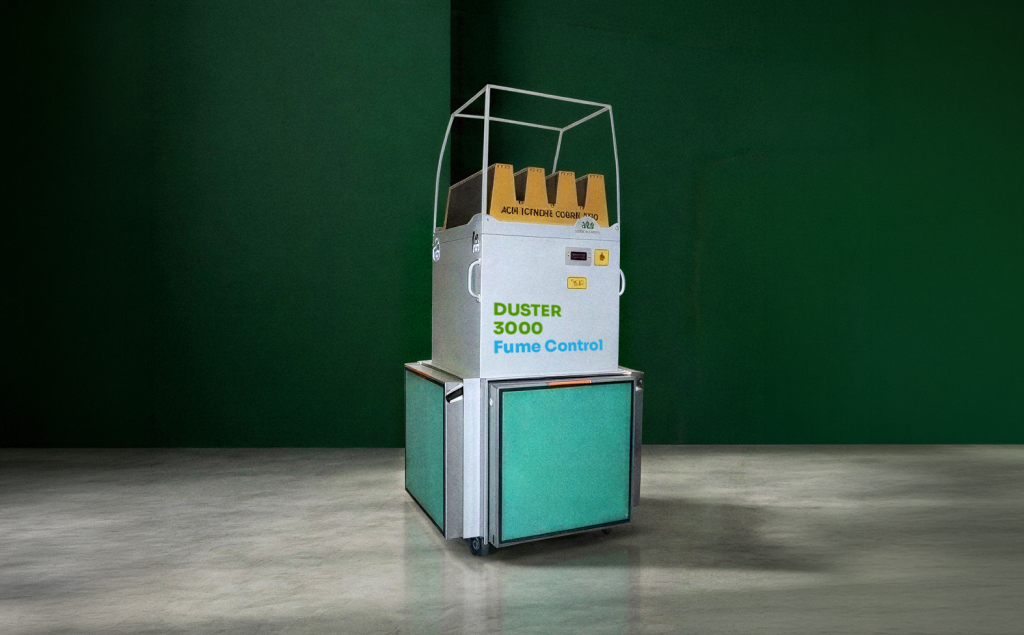
DUSTER 3000 Fume Control
Here's how Fume Control works .


The Fume Control draws in contaminated air through three intake vents at the base of the unit. The air passes through four filter stages and is returned purified from the top. This circulation creates a mushroom-shaped airflow pattern that can cover an area of up to 465 m².
The difference from the downdraft system: While the downdraft system captures dust and paint mist directly at the workstation, the Fume Control purifies the air in an entire area, removing fumes and odors.
4-Stage Filtration System
Double the activated carbon for maximum adsorption.
Stage 1 — Prefilter
, captures visible dust and particles.
Stage 2 — Main Filter
Pleated metal-frame filter. Captures particles down to 1 µm.
Stage 3 — Activated Carbon Filter
Activated carbon pellets. Removes solvents, VOCs, isocyanates, and odors.
Stage 4 — Activated Carbon Top Filter
Activated carbon granules for high vapor loads.
Total: about 27 kg of activated carbon.
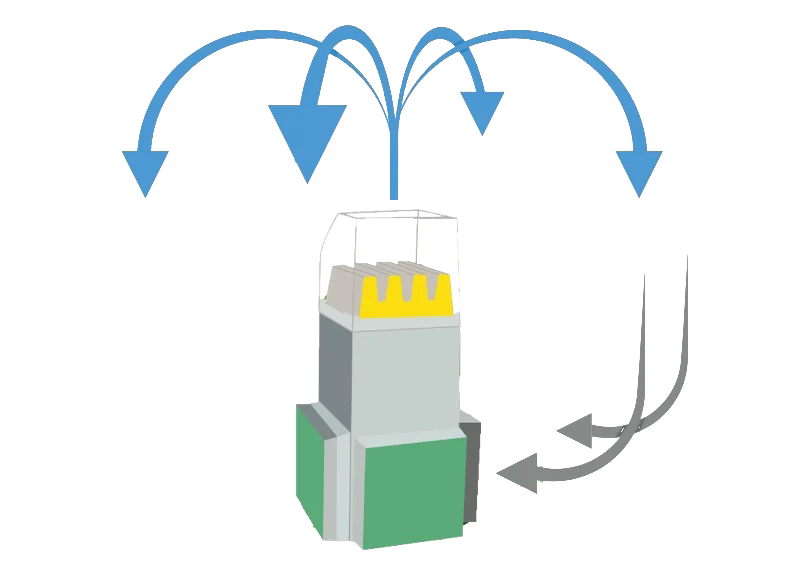
Cross-sectional diagram of airflow: The Fume Control draws air in at the bottom and expels it at the top.
Technical data
All specifications at a glance.
The unit comes fully assembled and with filters for the initial period of operation. On-site installation is not required.
Suction capacity
5,100 m³/h
Cleaning Area
up to 465 m²
Weight (without filters)
84 kg
Footprint
0.86 × 0.74 m
Height
1.83 m
Operating noise level
67 dB
Electrical connection
230 V, 1,500 W
Total activated carbon
27 kg
Warranty
3 years (optional up to 5 years)
Quality & Documentation
Proven quality from the DUSTER-3000 family.


The device has basic CE and ATEX certification and bears the corresponding nameplate. For the North American market, it also has CSA HazLoc certification for Class I, Division 2, Group D, as well as Class II, Division 2, Groups F and G—that is, for operation in potentially explosive atmospheres according to U.S. and Canadian classifications.
Areas of Application
Where solvents and fine particulate matter are produced.
Printing companies with large-format digital printers. Industrial applications involving exposure to solvents and vapors. Anywhere where the entire area—rather than just a specific workstation—needs to be cleaned.
Large-Format Digital Printing
Solvent-based inks and cleaning agents in the printing work area, as well as talcum powder and paper dust.
Prepress and Postpress
Bonding, laminating, and finishing where solvents remain in the room.
Industrial Manufacturing
Coating and bonding in work areas where vapors and odors are produced.
Particulate Matter Instead of Fumes
When the MP85 top filter is used in place of the upper activated carbon stage, the filtration limit drops to 0.3 µm.
Economic Efficiency
Small investment, low operating costs.
A permanently installed ventilation system ventilates the entire room and must be designed, built, and inspected. The Fume Control system targets the source and is ready for use the day it is delivered.
Procurement
The investment is tied to the device
No wall demolition, no planning, no inspection. Capital stays in the business rather than being tied up in building systems. Available for purchase or lease, as desired.
In operation
Low operating costs
In recirculation mode, the heated air in your room stays inside the room, and your heating costs decrease accordingly.
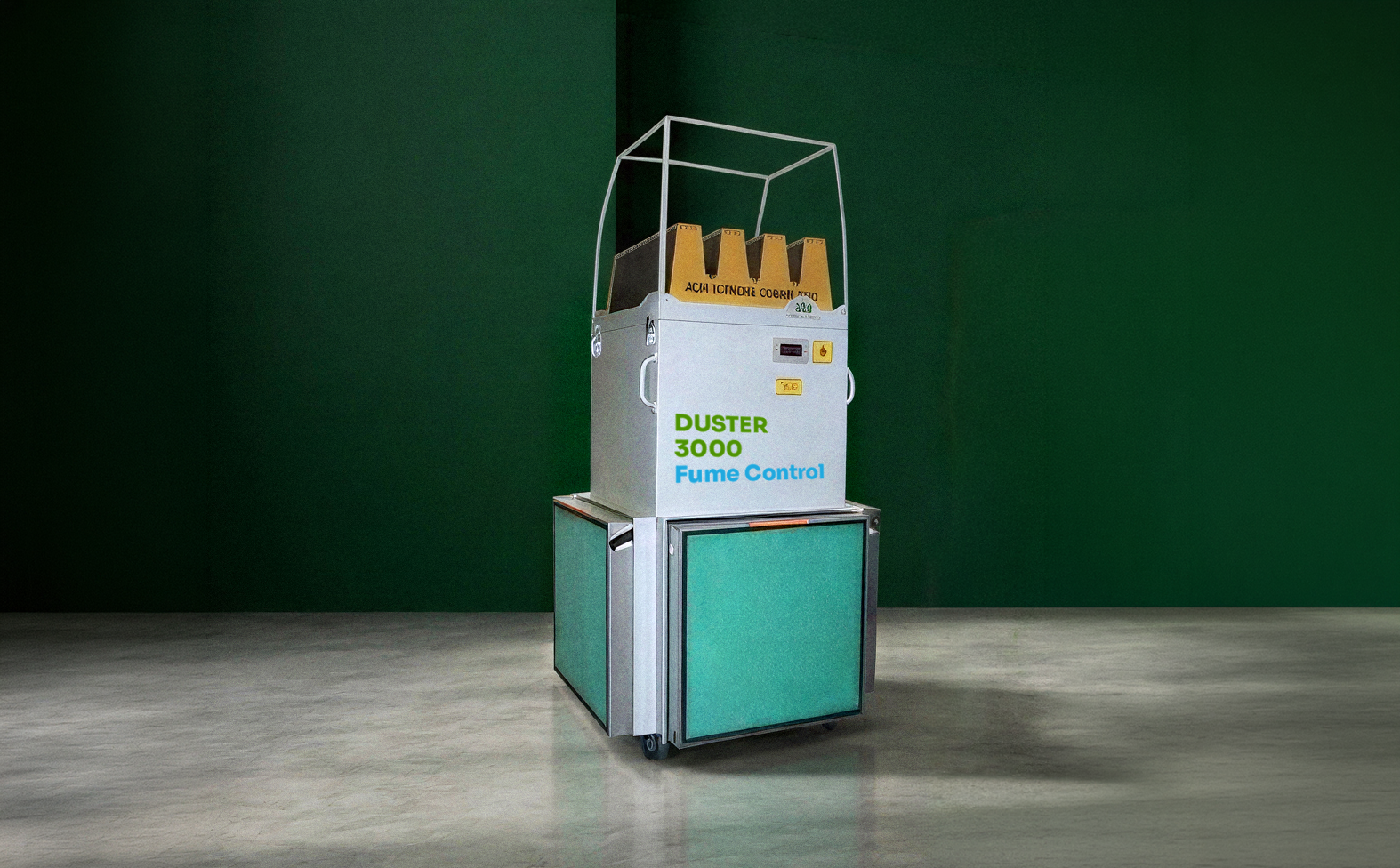
Filters & Accessories
Full performance only with original filters.
The amount of contaminants an activated carbon filter can remove depends on the quantity and quality of the carbon used. The documented filter performance applies to the original configuration with original filters. They are designed for use with solvents and isocyanates and are available directly from stock.
Downloads
Everything for reference.
DUSTER 3000 Fume Control Product Data Sheet
Operating manual
Product brochure
Frequently asked questions
Questions & answers.
Why isn't a fine-particle filter sufficient for solvent vapors?
Because fumes are gaseous. A particle filter traps solid particles, but gas molecules pass through it regardless of the filter class. Gaseous substances are adsorbed, and that’s what activated carbon does. The Fume Control has two stages of this, totaling about 17 kg.
Does the Fume Control replace an air-handling unit?
It purifies the air right where it becomes contaminated, and that’s sufficient in many workplaces. If workplace safety regulations require a ventilation system for your work area, this device does not replace it. This will be determined by your risk assessment, and we’ll review it together.
How can I tell when the activated carbon needs to be replaced?
By weight. The adsorbed solvents accumulate in the carbon and make the filter heavier. The lower activated carbon filter weighs 6.8 kg when new and is replaced when it reaches 11.3 kg; the top filter weighs 10.9 kg when new and is replaced when it reaches 21.3 kg.
How much space does the device take up?
The unit has a footprint of 0.6 m² and a height of 1.83 m. You should allow one meter of space around the unit for operation and filter replacement. The three intake openings on the base must remain unobstructed.
Does the Fume Control require a special power connection?
A standard 230-V outlet is sufficient; the device draws 6 A. The circuit requires a slow-blow fuse with a D rating because the motor draws a higher current for a short time when starting up. We recommend using a separate circuit.
Can I use a fine dust filter instead of the top activated carbon filter?
Yes. The MP85 top filter reduces the particle separation limit from 1 µm to 0.3 µm. This eliminates the need for the second activated carbon stage, so the adsorption capacity drops to 6.8 kg, which is the capacity of the lower stage. This replacement makes sense if invisible fine dust is the bigger problem.

