
DUSTER 3000 Downdraft
The all-around tool for sanding and painting processes.
The DUSTER 3000 Downdraft is designed for processes where it makes technical sense to position the extraction system close to the workstation. Instead of confining sanding, preparation, or painting work to a fixed workstation, the extraction system is positioned directly at the respective work area. Contaminated air is drawn in near the floor and filtered through a four-stage filtration system.
5,100 m³/h
Suction capacity
4-stage
Filter System
67 dB
Quiet operation
230 V
Standard outlet
ATEX II 3G
Explosion-proof
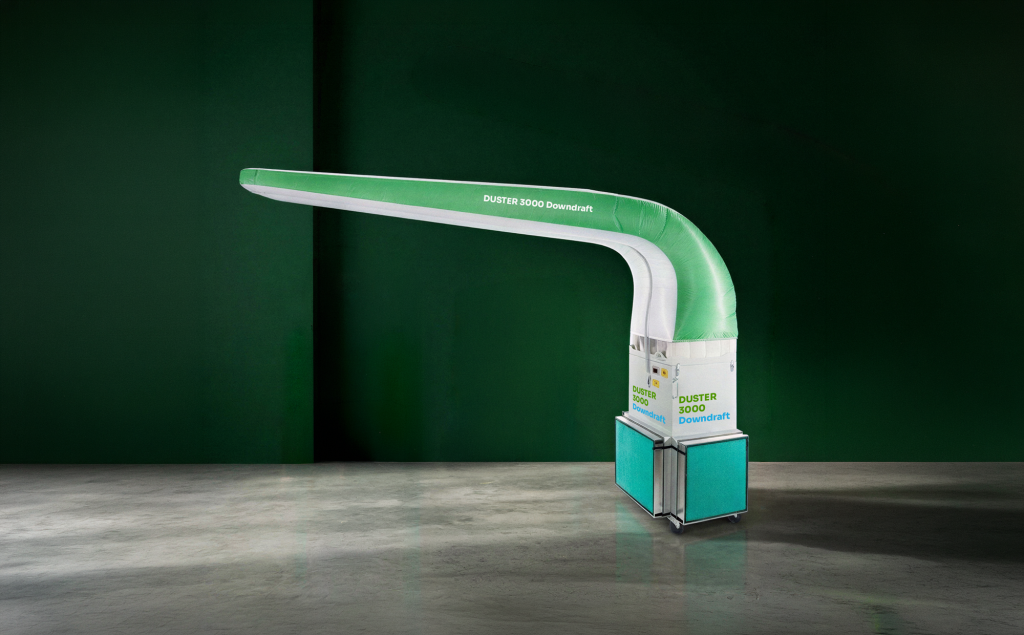
DUSTER 3000 Downdraft
Here's how the downdraft works .


The contaminated air is drawn in through the lower filter surfaces and purified in four stages. 95% of the purified air exits the unit at the top through a mesh, in a controlled and even flow to prevent dust from being stirred up. The remaining 5% is gently pushed downward through small holes in the plenum.
This counterflow creates a controlled airflow from top to bottom in the work area. Particles that fly in all directions during sanding or painting are directed back toward the filter surface. The worker operates in an area with continuously filtered air.
With recirculation mode, the conditioned air remains in the room. An exhaust vent is not necessary.
Downward flow from above
The plenum forces some of the purified air downward through fine holes, thereby keeping the air at the workstation moving downward. Air is drawn in from below through the filter surfaces. Enclosure exhaust systems, on the other hand, draw the air past the sides—that is, through the area where the employee is standing.
ATEX Zone 2 as standard
The Downdraft is certified under ATEX for Zone 2, Equipment Category II 3G. The certification is included as standard and is not an optional extra.
37,000+ in service
More than 37,000 units from the DUSTER 3000 series are in continuous operation at industrial companies. The technology is proven—it hasn’t been reinvented.
5,100 m³/h at 230 V
Full suction power from a standard electrical outlet. A high-voltage power line is not required for operation.
67 dB during operation
Measured at a distance of 3 m in accordance with DIN 45635-01-KL3. The ventilation system is running without anyone in the room having to speak loudly to be understood.
Filter performance tested
Filter Performance Documented — A sample air quality report documents filter performance under defined conditions. We will provide it to you upon request.
Operating principle
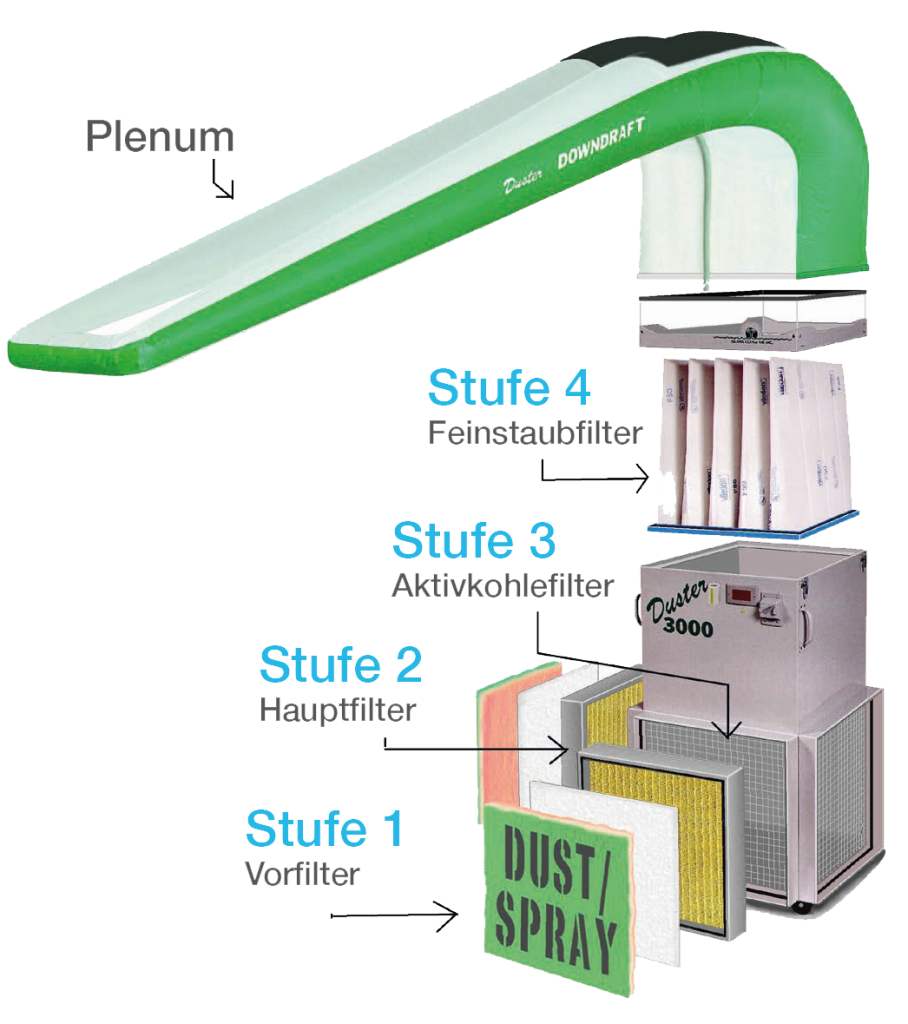
Drawn in from the bottom, cleaned in four stages.
Stage 1 — Prefilter
Special prefilter mat. Captures coarse particles, paint mist, and dust. Replace every 3–6 months.
Stage 2 — Main Filter
Pleated metal-frame filter. Captures particles as small as 5–10 µm. Replace every 6–12 months.
Stage 3 — Activated Carbon Filter
Activated carbon pellets for absorbing solvents, toxins, and pollutants. Replace every 9–18 months.
Stage 4 — Fine Dust Filter
Fine dust bag filter for the finest particles. Replace every 12–24 months.
Total: 17 kg of activated carbon. Filter service life depends on the intended use and frequency of use.
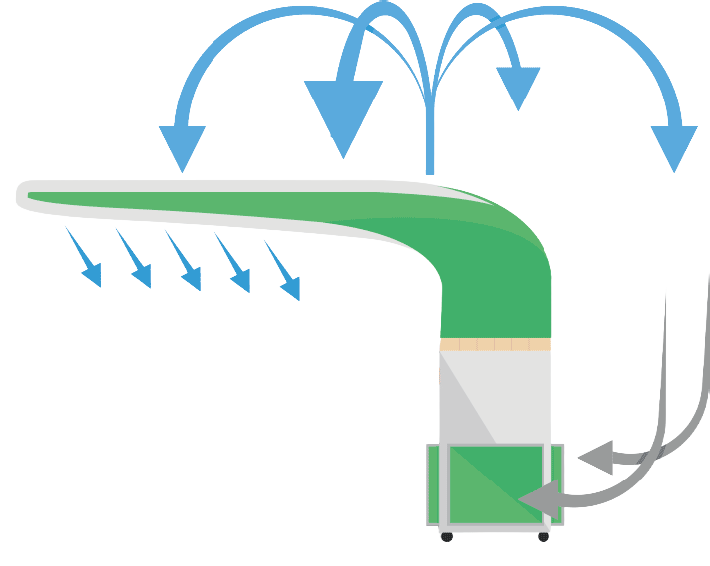
Cross-sectional diagram of the airflow: drawn in at the bottom, returned at the top through the mesh, with a small portion flowing downward through the plenum.
Technical data
All specifications at a glance.
Full power from a standard outlet, with an operating noise level of 67 dB. We can supply the exhaust-air version upon request; it achieves a flow rate of 8,500 m³/h.
Suction capacity
5,100 m³/h
Exhaust Air Flow Rate
8,500 m³/h
Filter area
approx. 9 m²
Weight (without filters)
84 kg
Footprint
0.8 × 0.9 m
Clearance height under the plenum
2.29 m
Total length including the plenum
3.6 m
Operating noise level
67 dB
Electrical connection
230 V, 1,500 W (8 A)
Warranty
3 years (optional up to 5 years)
Certifications & Documentation
Tested, measured, verified.


Listed in the Green Directory, 2010 (Automechanika).
The Downdraft is certified in accordance with the ATEX Directive 2014/34/EU for Zone 2 hazardous areas, Equipment Category II 3G—as standard and not as an optional extra. As the manufacturer and distributor for the European market, we bear the CE marking. The filtration performance is documented in a sample air quality report under defined conditions, which you can view upon request. Controlled air recirculation is ensured by the patented plenum, which generates the downdraft effect.
Areas of Application
One device, many uses.
Body & Paint
Sanding, filling, and spot painting during normal operations, right on the vehicle.
Car Dealerships & Fleets
Spot repair with high repair throughput. The unit is set up right where the next car is parked.
Vehicle Detailing
Processing centers and logistics facilities handling large volumes.
Industry
Industrial sanding and painting workstations, available with a plenum extension for large components upon request.
Economic Efficiency
Small investment, low operating costs.
The unit comes fully assembled and requires a 230-volt outlet.
Procurement
The investment is tied to the device
The Downdraft comes fully assembled and requires a power outlet. No structural preparations are needed, so capital remains tied up in operations rather than in the building itself. Available for purchase or lease upon request.
In operation
Lower operating costs
In recirculation mode, the heated air inside your facility remains in the room, and heating costs are reduced accordingly. Where exhaust air must be vented outside, we offer the same machine in an exhaust-air version.
Filters & Accessories
Full performance only with original filters.
The four-stage filter system uses four different types of filters with varying service lives. The documented filter performance applies to the original configuration with original filters. How long a filter lasts depends on its intended use and frequency of use.
Extensions
Accessories for the DUSTER Downdraft
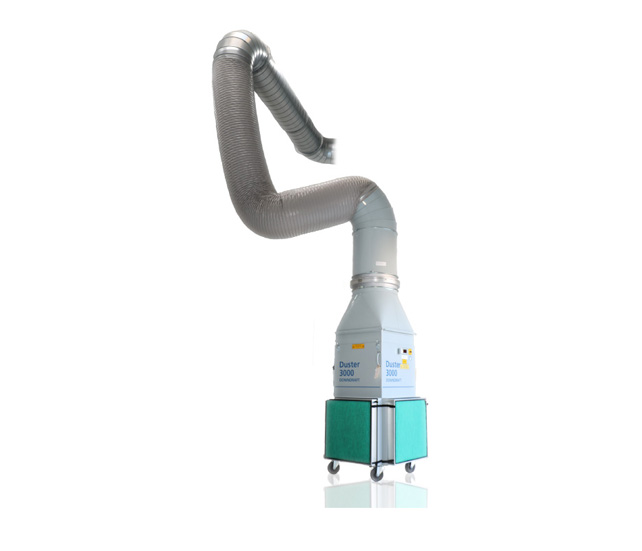
Exhaust Mode
Optional with an exhaust hood. For the rare occasion when you don’t want the air to remain in the room.
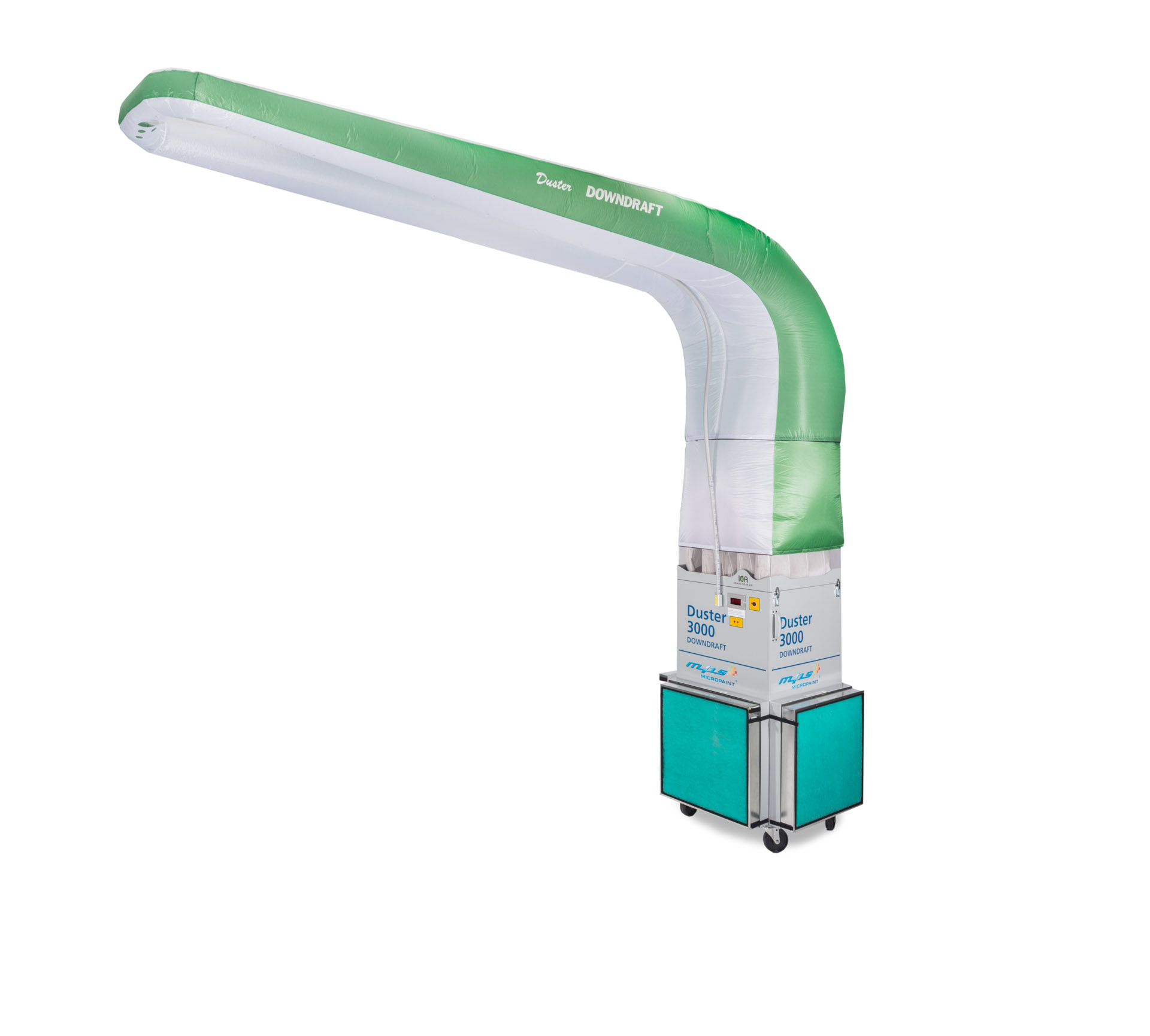
Extension of the Plenary Session
Available in 60-cm and 120-cm increments, up to a maximum of 500 cm. For larger components and entire vehicles.
Downloads
Everything for reference.
DUSTER 3000 Downdraft User Manual
DUSTER 3000 Downdraft Product Brochure
Frequently asked questions
Questions & answers.
Where is the downdraft located during operation?
Wherever sanding, filling, or spot painting takes place. The unit rolls up to the workstation and captures dust and paint mist right where they are generated, without requiring the workpiece to be moved.
Is it permissible to have the downdraft unit in areas at risk of explosion?
It is certified according to ATEX for Zone 2, Equipment Category II 3G. Zone 2 refers to areas where an explosive atmosphere does not occur during normal operation and, otherwise, only for short periods. The device is not approved for Zone 0 or Zone 1. Your explosion protection document specifies which zone your work area falls under.
How much space does the device take up?
The base plate measures 0.8 by 0.9 meters; when the unit is turned off, it requires about one square meter of floor space. You should allow one meter of space all around the unit for operation and maintenance. The minimum ceiling height is 3.5 meters.
Does the downdraft require a special electrical connection?
No, a standard 230-V outlet is sufficient. We recommend using a dedicated circuit so that the device can operate at full power.
How often do the filters need to be changed?
The pre-filter and main filter can be cleaned, which extends their service life. The activated carbon and fine dust filters need to be replaced. Their service life depends on your usage, so we’ll work with you to determine the replacement intervals. The digital airflow indicator on the unit alerts you when the filters need attention.
Is the Downdraft also available as an exhaust fan?
Yes. In the exhaust mode, an exhaust hood directs the filtered air outside through a hose, achieving a flow rate of 8,500 m³/h. This is a good option if you don’t want the exhaust fumes to re-enter the room. In recirculation mode, the heat stays in the room. We’ll determine in advance which operating mode is best suited for your materials.

